

IMPACT OF COACHING AT AGILE AND CULTURAL TRANSFORMATION?
IMPACT OF COACHING AT AGILE AND CULTURAL TRANSFORMATION?
Although agile work is predominantly settled in minds as a methodical way of working, it actually requires a cultural transformation at its core. One of the main reasons behind this misconception emerges at the point where the agile mindset is matched with the change in organizational structure and titles. In order to facilitate and enable this transformation process, the need for coaching by people with different roles and experiences becomes even more important in agile organizations. This need arises not only for individuals in organizations, but also for teams and roles, for different reasons.
In a place where agility is defined as the ability to respond quickly and easily to the challenge of change, the first need basically emerges with the individual and the organization’s statements such as “We were already agile” and “What was needed now when things were going so well?” Although these statements are generally called resistance to change, defining this as a need to understand from a very human perspective is actually a more empathetic perspective.
Business Agility Institute defines “Agility in Business” as the combination of organizational competencies, behaviors, and the ability to achieve one’s goals regardless of what the future may bring by supporting freedom, flexibility, and resilience.
In order to strengthen agility, many organizations are reconsidering their current processes and changing their organizational structures as well as their physical working conditions to ensure a difference in behaviors. When it comes to changes in behaviors, changing the organizational structure alone is not enough as a driving force. For this reason, the need for cultural transformation and coaching at all levels to create behavioral changes come to the fore.
It is also important to ensure a clear unity of purpose in vision and strategy, most importantly to define the values and how part, and of course, the most difficult part is to live these values not only in the organization but also in the entire ecosystem. In order to connect the rings of this whole chain, creating awareness and passion at every level about why transformation requires serious time, different communication methods and effort. Institutions use coaching and mentoring as an effective tool at this point. The fact that agile organizations can perform better in difficult conditions compared to traditionally operating companies of similar size is based on having a clear unity of purpose in their strategies. This encourages dynamism and teams united around a passion to produce even more value.
In traditional organizations, processes are activated and customer demands are met with management approval. Unfortunately, it is not possible to overcome this by simply establishing an agile organization. This can only be overcome with collective alignment and adoption throughout the organization. In the absence of this, a sense of inconsistency begins to form in the teams in the organization. This feeling is one of the issues that damages the belief in transformation the most. The need for authorization at different levels in the organization and, with this, dependence on authority occurs. These disruptions result in an increase in delivery time to the customer and a decrease in customer satisfaction.
The dependence on authority creates an environment that does not learn by its own nature and constantly needs the touch of a heroic leader. With the possible lack of tolerance for making mistakes and the fear of being audited or criticized, employees are afraid to take initiative. After a while, the organization focuses on pleasing its leader and doing its job flawlessly, rather than on purpose and vision. The existence of coaches who accompany the teams in the agile transformation process, making these obstacles transparent and encouraging the implementation of platforms where stakeholders and teams can align, is important at this point. Of course, this is directly related to how these companies position and authorize their coaches within the organization. Unfortunately, it is not possible to make the transformation sustainable at the point where you gather the power of a single team or leader within the organization without ensuring that the transformation is internalized on the basis of all areas within the organization. Not everyone prefers to take a step towards a single leader or team and implement the transformation.
All research and experience on change management show that change management is a change and transformation related to people. Making change possible is only possible by ensuring cultural transformation. Peter Drucker actually draws attention to this necessity with the saying “Culture Eats Strategy for Breakfast”. Making cultural transformation possible is possible by identifying pain points within the organization, making them visible and taking steps regarding them. Employees now want to work in companies with a vision they can understand and values that match their own with which they can establish a connection. The organization needs you to clarify the values and principles of the organization culture along with your vision. This clarification actually serves as a compass for employees. Being able to tell your employees to look at our vision, values and
principles when they cannot make a decision or the environment is not clear strengthens the flow and autonomy in the organization.
In order to manage the cultural change process in a healthy manner, companies receive coaching at different levels to make the process more manageable for their employees. Starting with the leaders, team coaching, individual or group coaching are used as important tools to create awareness in the organization about pain points and then to take action for the organization. The need for coaching, which was previously considered a last resort for leaders who had problems, is now seen as a need to reveal the potential of organizations, and in-house coaches with the title of ACC or PCC, who are also proficient in agile working methods and business processes, are employed within the structures called “Agile Studio” within the agile working companies.
One of the important competencies of the roles called “Agile Coach” in agile organizations is professional coaching.
gile Coach helps individuals, teams and organizations to make cultural transformation possible so that they can work in accordance with human-centered agile principles, practices and values. Cultural change helps individuals and organizations exist in the ever-changing business world.sürekli değişen iş dünyasında var olmasına yardımcı olur.
Although Agile Coaching, unlike professional coaching, requires knowledge and application of agile-related practices and knowledge of business processes, professional coaching is also included in the development and learning journey of the agile coach. The competencies that an Agile Coach should have are explained in the visual below in Lyssa Adkins’ book “Coaching Agile Teams”.
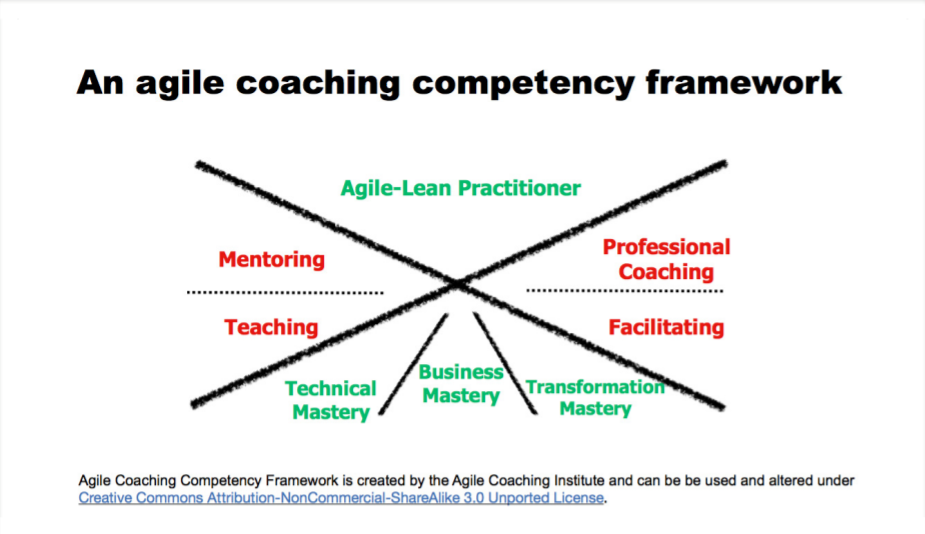
Professional coaching competencies are applied by agile coach on an individual and team basis. It is possible to enable individuals to adapt to changing conditions and sometimes roles, thus revealing the potential of individuals and the organization. As an agile coach, team coaching techniques are used in events called retrospectives where the team evaluates itself, and group coaching techniques are used in issues that require development on a role basis, allowing people in similar roles to reach common sharing and awareness and find solutions. It has been observed that the PM360 and GROW models are effective methods in coaching studies conducted with leaders who are trying to adapt to their roles or who request support regarding the development process.
Individuals’ requests for coaching may arise from the awareness that team members have about themselves in team coaching sessions and the need for clarification on this, or they may be requested regarding a specific development area in order to support the personal development plans of leaders to whom individuals who have difficulty adapting to the agile working process are affiliated.
Change will be on our agenda even more in the coming period with different technologies, especially artificial intelligence, and the differentiation in customer demands. Therefore, we may be entering a period where institutions will adopt a different employment policy within their organizational structures instead of the usual hierarchical leadership roles. If you wish, let us leave the opportunities that these possibilities and developments will offer us to our future posts.